2026 sustainability opportunities you might be missing
Visionect, 27 Jan 2026
Every January, sustainability rises to the top of the agenda. This year, the focus on greener buildings feels especially urgent. Cities are introducing stricter building performance standards, while organizations face growing pressure to reduce emissions in visible and measurable ways.
Offices, hospitals, universities, and residential buildings are all being asked to operate more efficiently. The challenge is finding practical ways to improve sustainability without disrupting daily operations or committing to large, long-term infrastructure projects all at once.
Why sustainable building operations are becoming a business priority
Understanding why sustainability is essential for both compliance and long-term efficiency helps organizations make smarter operational decisions.
Regulation is accelerating sustainable building requirements
Buildings account for a significant share of global energy consumption, which is why they’re increasingly targeted by climate policy and regulatory frameworks. Energy benchmarking, carbon reporting, and building performance standards are becoming common across cities worldwide.
Sustainability expectations go beyond compliance
Expectations are also shifting among investors, employees, tenants, and customers, many of whom are paying closer attention to how sustainability commitments translate into everyday building operations.
Facilities and operations teams face real constraints
Facilities and operations teams are often the ones tasked with delivering sustainability improvements, usually while working within tight budgets and limited staffing.
Large infrastructure upgrades certainly matter, but they also tend to involve:
- Significant capital investment
- Long planning and approval cycles
- Extended implementation timelines
- Disruption of daily operations
Meanwhile, buildings continue to consume energy every single day.
Practical, low-effort sustainability improvements are gaining momentum
Many organizations are prioritizing operational changes that are easier to implement and maintain. Small improvements can have a meaningful impact when applied consistently across buildings.
One area seeing real results is how information is shared. Instead of relying on printed notices or energy-intensive digital signage, organizations are exploring low-power digital alternatives, such as e-paper signage, to support sustainability goals without adding operational complexity.
See how Place & Play supports low-impact digital communication.
How daily building operations affect energy use and sustainability goals
When most people think about sustainable buildings, they picture big systems like heating, cooling, and lighting. Those aspects are important, but they’re not the whole story.
Everyday tools and processes quietly add to a building’s energy footprint. Screens that run 24/7, printed notices that need constant replacement, and manual updates all consume resources. It’s easy to overlook the impact of these tools because it builds up gradually.
In large or multi-site buildings, these small inefficiencies multiply. What seems minor in one location can create a significant impact when repeated across dozens or hundreds of spaces.
By optimizing these everyday systems, organizations can cut energy use, reduce waste, and simplify workflows for facilities and communications teams, making sustainability both practical and visible.
Why visible sustainability efforts matter to tenants and employees
Sustainability is no longer invisible. Tenants, employees, and visitors notice how buildings operate on a daily basis.
Printed notices taped to walls, outdated signage, or bright screens running in empty spaces can undermine sustainability messaging. When environmental commitments are not reflected in everyday decisions, people notice the disconnect.
Signage plays a key role because everyone sees it. Unlike hidden mechanical systems, it’s experienced firsthand, and thoughtful displays can signal a building’s commitment to efficient, responsible operations.
The environmental impact of traditional digital signage and printed notices
Different types of signage have unique environmental and operational impacts, which can influence a building’s sustainability efforts.
| Signage Type | Environmental impact | Operational Impact |
| Traditional digital signage (LCD) | Constant backlighting and continuous power use, even when content is static or spaces are empty | Higher electricity consumption over time |
| Printed signage | Uses paper and ink; requires frequent reprints | Generates waste and increases staff time for updates; quickly becomes outdated in dynamic environments |
How e-paper digital signage reduces energy use in buildings
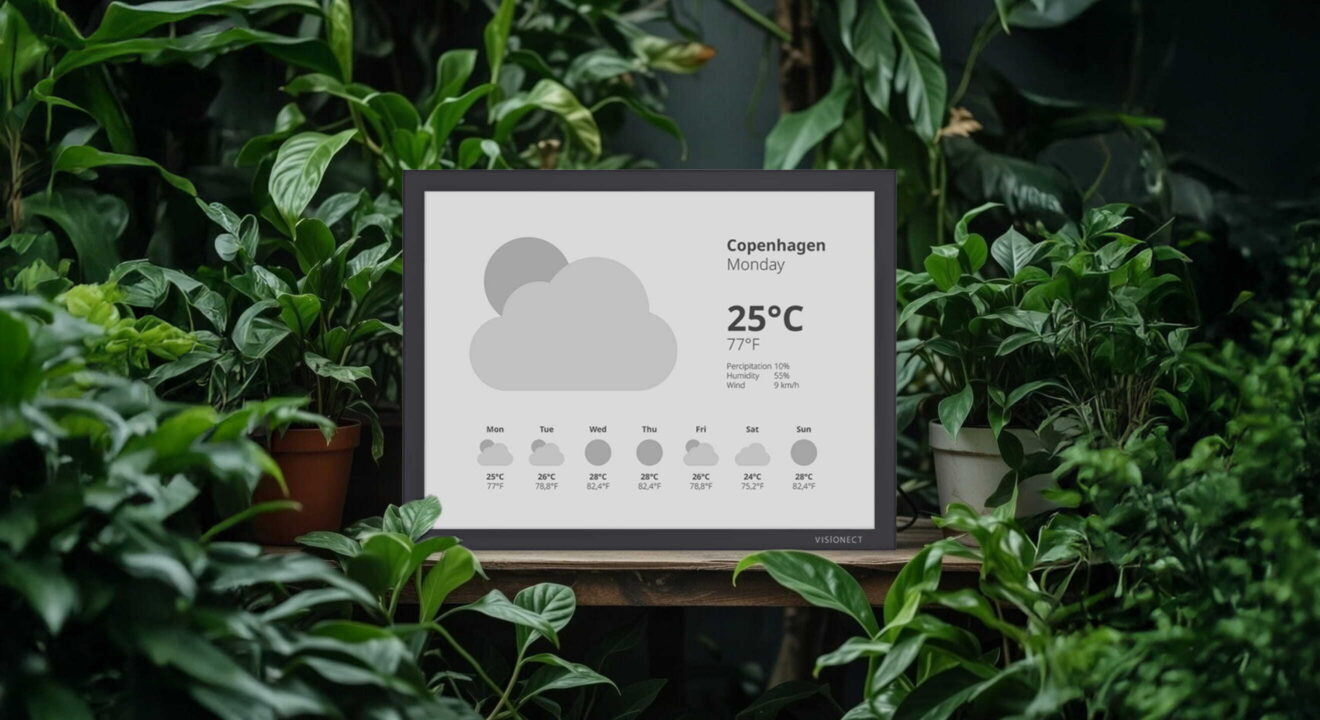
E-paper digital signage provides a more energy-efficient alternative. Using the same technology found in e-readers, e-paper displays consume power only when content changes. Once updated, the display remains visible without ongoing electricity use.
For building operators, this makes it possible to provide clear, always-on information without the energy demands of traditional screens. Room schedules, wayfinding, safety notices, and tenant updates remain accessible around the clock.
Environmental impact:
- Minimal energy use; consumes power only when content changes
Operational impact:
- Reduces electricity consumption, replaces printed notices, allows remote updates, and lowers staff workload;
- Wireless installation is fast and doesn’t disrupt daily operations
- Ideal for always-on, static information like schedules, wayfinding, and notices
Discover 11 use cases for e-paper digital signage.
Place & Play e-paper digital signage
With an e-paper signage system like Visionect’s Place & Play, organizations can:
- Reduce electricity consumption compared to LCD digital signage
- Replace printed notices across multiple locations
- Update content remotely and consistently
- Reduce manual labor for facilities and communications teams
- Place wireless digital signage wherever needed
E-paper signage is especially well suited for offices, hospitals, universities, residential buildings, and public spaces where information needs to remain visible without animation.
Scaling sustainable building technology across multiple locations
Many sustainability initiatives begin with a single building and later expand across a portfolio. A solution that works in one location must be scalable enough to support different layouts, use cases, and budgets.
The Place & Play CMS supports both LCD and e-paper displays within a single content management system. Organizations can modernize signage gradually, using energy-efficient displays where they provide the greatest benefit while continuing to support existing screens elsewhere.
This flexibility helps organizations adapt as sustainability regulations evolve and operational needs change, without investing in systems that become difficult to scale or maintain.
Making energy-efficient signage part of long-term building sustainability
The most effective sustainability strategies don’t live in a spreadsheet or a one-time initiative. They’re built into everyday operations and keep working in the background without constant oversight.
That’s where low-energy digital signage makes sense. Once it’s in place, it quietly reduces waste, lowers energy use, and makes it easier for teams to keep information up to date across buildings.
No single change will make a building sustainable overnight. But practical choices like these add up over time, helping organizations align day-to-day operations with long-term environmental goals.
Ready to step toward greener building operations? Learn how Visionect Place & Play supports energy-efficient digital signage at scale.